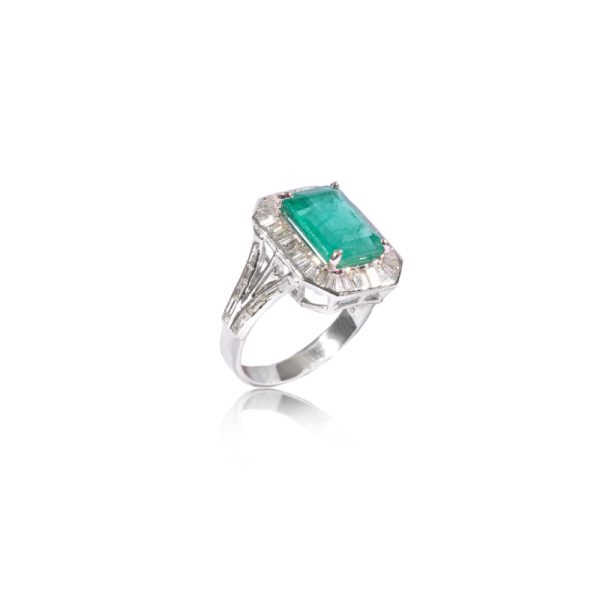
Two pieces can use stones of the same size and purity, yet one looks like anonymous luxury while the other has a clear personality. The difference is rarely in carats alone; it lies in how the designer works with line, proportion and the empty space around the stone. A recognisable jewel is read as a whole, not only through its central diamond: it has a silhouette you could almost trace in the air with one gesture. That silhouette is what makes a piece stand out in a window and feel “right” for a particular person.
Silhouette First, Details Later
If you half close your eyes and look at a ring or pair of earrings from a distance, small stones and surface texture fade, leaving only the outline. A designer who thinks in silhouettes sets the character of the piece long before anyone notices the facets. A clear oval, an asymmetric curve, a strong vertical line or an unexpectedly wide base all make a jewel recognisable in a second. When the silhouette is weak, the eye wanders across details and the piece gets lost among similar designs. The same principle works in entertainment branding, where platforms like 1win casino rely on a strong visual identity and instantly recognisable style to stand out in a crowded space.
Proportions of Stone and Metal
The role of a diamond in the composition depends on how much visual space it occupies next to the metal. In some designs the stone dominates and the setting almost disappears; in others the metal frames it like a painting and sets the mood. Too much metal around a small stone makes the piece look heavy, while a very thin setting around a large diamond can feel fragile and unbalanced. Well judged proportions create calm: nothing feels too loud or too weak, and the eye perceives one harmonious form.
The Rhythm of Repeated Elements
In bracelets, necklaces and earrings, rhythm plays the role melody plays in music. Repeated elements can march evenly, creating a quiet architectural pattern, or change in size and spacing to suggest movement. When the rhythm is deliberate, the piece “sits” on the body: a bracelet follows the line of the wrist, a necklace traces the curve of the neck. Random repetition feels like a string of parts rather than a composition and gives no clear visual voice to the jewel.
Empty Space as Part of the Design
Many people still associate fine jewellery with surfaces filled edge to edge with stones, yet the air around them often makes a design feel modern and light. Open metalwork, geometric cut outs and stones that seem to float create light and shadow that a solid surface cannot. Empty areas allow skin to become part of the composition: a ring or necklace is not just placed on top but draws lines directly on the body. Because of this, even pieces with few stones can be instantly recognisable, remembered for their graphic pattern rather than sheer sparkle.
Signature Motifs of a Designer
Strong jewellery houses and individual designers almost always have a recognisable “signature”. It might be a favourite curve, a particular type of setting, a way of mixing matte and polished surfaces or the way stones are suspended in space.
- A recurring line or curve that appears in rings, earrings and necklaces.
- A characteristic balance of metal and stones that feels unique to the brand.
- A specific way light is used — through cut outs, layering or unexpected angles.
Once a customer becomes familiar with this visual handwriting, they can recognise the creator’s work even without a logo, and the piece starts to feel like part of a larger story.
Knowing When a Design Is Yours
Recognisability matters both from the outside and from within: a person needs to recognise themselves in a piece. If your hand reaches for the same ring or necklace again and again, the lines and proportions have aligned with how you see your own style. It helps to notice which shapes feel natural on you: soft ovals or sharp angles, symmetry or controlled asymmetry, quiet minimalism or bold drama. When design fits this inner picture, a jewel stops being a sum of materials and becomes a visual signature you are comfortable wearing every day.
When the Diamond Is Only Part of the Story
Stone quality matters, but it does not guarantee that a piece will have a long life in someone’s jewellery box. A jewel becomes truly valuable when it is easy to remember: “that ring with the flowing line”, “those earrings where the stone hangs in the air”, “that necklace that draws geometry on the collarbone”. In such pieces the diamond does not compete with the metal; it lives inside a clear image you could describe without numbers and certificates. Design is what makes jewellery recognisable at first glance and turns precious materials into a personal mark someone will want to wear for years.